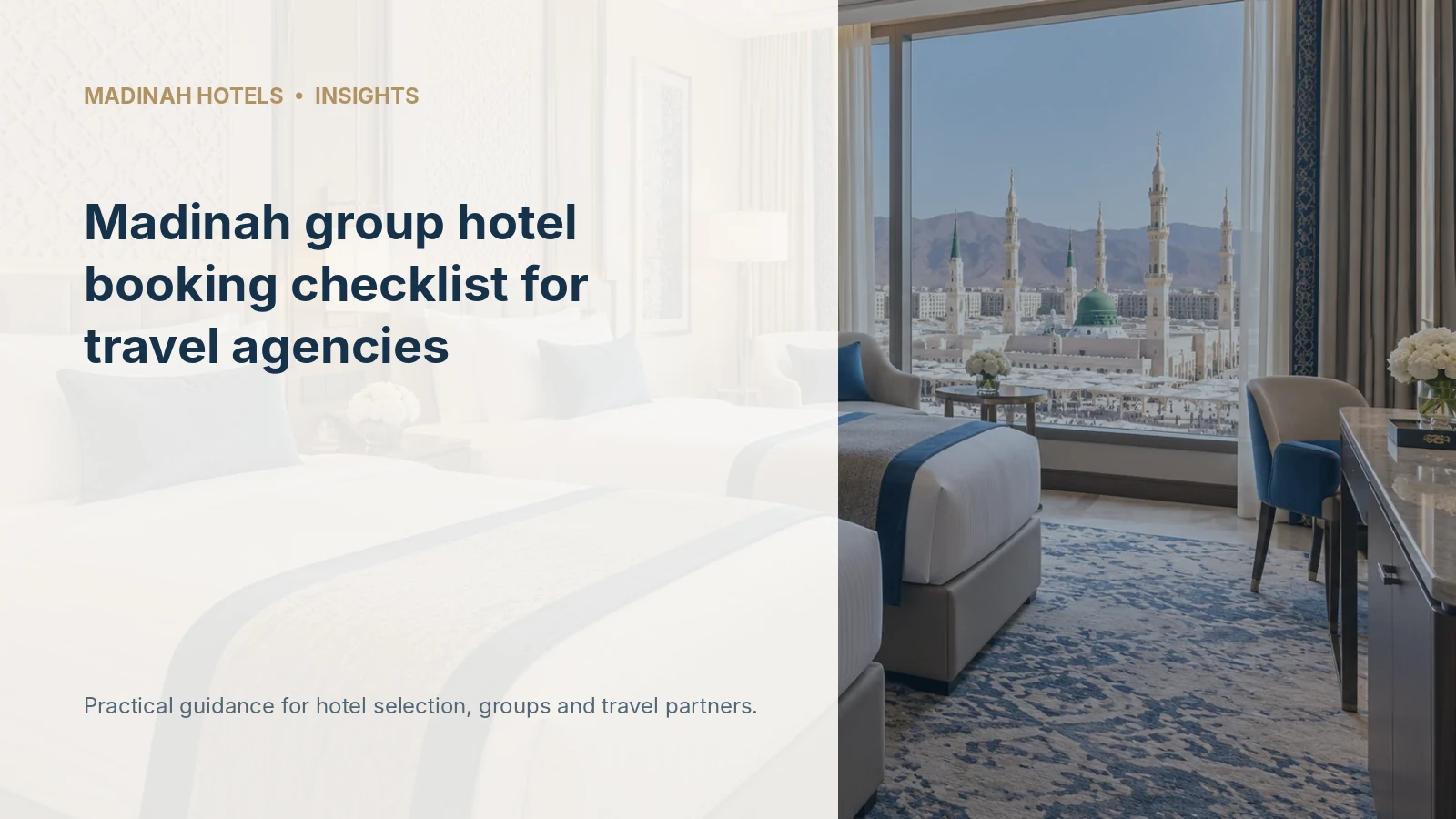
A group enquiry becomes much faster to review when the essential information is complete from the start. This checklist is designed for travel agencies, Umrah operators and organisers preparing Madinah accommodation requirements.
A complete request lets the accommodation team compare the correct access band, rate period and room structure without repeatedly asking for missing details.
1. Confirm the exact check-in and check-out dates
Dates determine which seasonal rate period applies. The current portfolio is structured across three date bands, so a request without exact dates cannot be compared accurately. If the dates are provisional, mark them as provisional instead of presenting them as final.
2. State the total traveller count
Provide the expected number of travellers and identify whether the count is firm or still changing. This gives context to the room requirement, but the traveller count alone is not enough to price or allocate a group.
3. Prepare the room and occupancy mix
Write the room mix explicitly. The rate sheet uses Sharing / Special Occupancy and a combined DBL / TPL / QQ rate column, with Quint-specific values at selected properties. Do not assume that one combined figure can be split into separate Double, Triple and Quad prices unless the contracting arrangement confirms that.
| Information | Good example | Avoid |
|---|---|---|
| Total travellers | 42 travellers | “Around 40” with no room plan |
| Room mix | 4 Double, 6 Triple, 4 Quad | “Need 14 rooms” only |
| Dates | 18–23 November | “November” |
| Access | Prefer 100–400 m | “Near Haram” |
4. Define the acceptable access level
Tell the team whether the group requires close walking access, can accept 300–400 m, is comfortable with 500–700 m, or is open to shuttle accommodation. This one decision can reduce a 14-hotel portfolio to a practical shortlist immediately.
For a group with elderly travellers or mobility concerns, start with 100–250 m hotels. For a value-led programme with more flexibility, compare the 500–700 m category and shuttle hotels.
5. Include preferred hotels if the agency already has a shortlist
If the group has a first choice and one or two alternatives, list them in order. For example, an agency may ask to check Rama Al Madinah first, Ergwan Al Madinah second and Burj Muwaddah as a wider-access alternative. A ranked shortlist is more actionable than sending a long list without preference.
6. Add the agency and contact details
For B2B requests, include the agency or operator name, operating country, contact person, email and an active WhatsApp number. This helps separate a trade enquiry from a direct traveller request and supports faster follow-up.
7. Flag special operational requirements early
If the group has accessibility needs, unusual arrival timing, a strong preference for shuttle operation, or another hotel-specific requirement, mention it before the shortlist is confirmed. Do not wait until the final stage to introduce a condition that could change which property is suitable.
8. Keep the website rate display and final confirmation separate
The website is designed for comparison. It shows the current contracted seasonal structure so agencies can understand the portfolio before enquiring. Current availability, booking position and final commercial terms still require confirmation.
Recommended group request format
Country:
Contact name:
WhatsApp:
Check-in:
Check-out:
Travellers:
Rooms:
Occupancy mix:
Preferred access:
Preferred hotels:
Special notes:
Before pressing send: final check
- Dates are exact or clearly marked provisional.
- Traveller count and room mix agree with each other.
- Access preference is realistic for the group profile.
- First-choice and backup hotels are listed where possible.
- The contact number can receive WhatsApp replies.
When the requirement is ready, use the Group Accommodation page or send it directly through Request Rates.
9. Decide who can approve alternatives
Before the enquiry is sent, identify who in the agency can approve a fallback hotel or wider distance. If every alternative has to be re-approved from the beginning, even a strong shortlist can stall. A clear approval threshold makes the booking process more efficient.
10. Keep the final confirmation separate from the working shortlist
A shortlist is a planning tool, not a confirmed allocation. Once the final hotel and commercial terms are agreed, store that confirmation separately from the earlier comparison notes so operations staff do not accidentally work from an outdated option.
Extra checks before confirming an Umrah group hotel
Before the final hotel is confirmed, the agency should check whether the rooming plan still matches the traveller list. A group that begins as mostly Quad rooms may change once families, elderly travellers or private-room requests are identified. Re-checking the occupancy mix before confirmation prevents the cheapest-looking option from becoming impractical later.
The same applies to access. If marketing material promises a hotel near Masjid an-Nabawi, the selected property should remain within the access range communicated to the traveller. Where shuttle service is used, confirm how the transport plan fits prayer times and the group schedule rather than assuming it operates continuously.
For repeat B2B work, keep a standard requirement template. It should contain dates, traveller count, room quantities, occupancy mix, first-choice hotel, alternatives, access ceiling and the agency contact. That simple discipline makes future Madinah hotel requests faster and easier to compare.
Turn the guidance into a hotel shortlist.
Compare the hotel portfolio by access, then send your dates and room requirement for current confirmation.